

Pecan Pie Bark guide: The ultimate quick, easy, irresistible treat 🍫🥧
Ready for the most irresistible Pecan Pie Bark guide that takes just minutes to master? You’ll absolutely love how this Pecan Pie Bark guide turns pantry staples into a game-changing sweet that’s crunchy, nutty, and perfect for gifts, potlucks, or a cozy night in. In this article you’ll learn a foolproof method, why the flavor balance works, easy substitutions, pro tips, and creative variations to make it your own. Expect quick wins, budget-friendly choices, and family-approved tweaks that anyone can follow.
Want a head start? Try this classic basic recipe while you read on: 1. Preheat the oven to 350°F and line a quarter sheet pan or 9×13 baking dish with parchment paper. 2. Arrange the graham crackers (or saltine crackers) in a single layer, covering the entire surface. 3. In a saucepan, melt butter, brown sugar, granulated sugar, corn syrup, ground cinnamon, and salt together over medium heat. Bring to a rolling boil and cook for 2 minutes, stirring constantly. 4. Remove from heat and stir in pecans and vanilla extract. 5. Pour the caramel mixture evenly over the graham crackers and spread gently with a spatula. 6. Bake for 10 minutes, or until the caramel is bubbly. 7. Let cool completely, then break into pieces.
Looking for holiday inspiration while you bake? Check this festive apple cake idea for pairing suggestions: Jamie Oliver Apple Pie Cake. 🍏
Attributes Origin & Cultural Context 🌍 (H2)
Pecan pie and toffee-style bark both have Southern U.S. roots, and Pecan Pie Bark cleverly combines the two: the nut-forward richness of pecan pie with the snap of toffee and a chocolate finish. Historically, pecans became prominent in Southern cuisine after the nut was cultivated and popularized in the 19th century. The modern bark variation is a more portable, candy-like evolution — perfect for gift tins and cookie swaps.
A quick family note: my grandmother loved to make pecan-based desserts at Thanksgiving, but she’d always skip the pie crust because she said “life’s too short for soggy bottoms.” That spirit lives in this recipe — all the flavor with less fuss. For a complementary dessert pairing (white chocolate + cranberry + pecan), try this seasonal idea: White Chocolate Cranberry Pecan. 🎁
What makes this version special? It’s intentionally simple: graham crackers as a crunchy base, a buttery-sugar caramel studded with toasted pecans, and an optional chocolate layer to balance the sweetness. Regional variations can include using different nuts (walnuts or almonds), swapping corn syrup for maple syrup, or adding spices like nutmeg or ginger for a warming twist.
SEO note: if you’re searching for an “Authentic Pecan Pie Bark origin” or a “Traditional Pecan Pie Bark guide,” this section gives both historical context and family-tested tweaks.
Why This Pecan Pie Bark Guide is a Game-Changer ⚡ (H2)
This Pecan Pie Bark guide isn’t just another recipe — it’s a learning framework that teaches the why as well as the how. Below are the reasons it stands out, with practical benefits you’ll notice at each step.
-
Lightning Fast: From setup to cool-down, this method takes about 45–60 minutes active + resting. You’ll be able to prepare and gift-bake in an afternoon or between errands. If you want a deeper how-to for beginners, this is the best Pecan Pie Bark guide for beginners and quick learning.
-
Budget-Friendly: Uses pantry staples — butter, sugar, graham crackers, and pecans. No specialty gadgets required. Swap pricey pecans for mixed nuts or use store-brand crackers to save. Buying pecans in bulk during sales cuts cost significantly.
-
Family Approved: Kids can assemble cracker layers and sprinkle pecans; adults supervise the hot caramel. This is an easy Pecan Pie Bark learning activity for families and groups.
-
Nutritiously Delicious: While it’s an indulgence, the nuts provide protein and healthy fats. Psychologically, sharing sweet treats at gatherings boosts social bonding — sugar triggers small dopamine hits that enhance feelings of reward and memory formation, making this dessert great for celebrations.
-
Infinitely Customizable: Want salty-sweet? Add flaky sea salt. Want seasonal? Stir in candied orange peel or chopped dried cranberries. The technique teaches flavor-building skills you can adapt across desserts.
-
Pantry-Friendly: Most ingredients live long in storage (sugar, crackers) or are fridge-stable (butter, nuts if refrigerated). This is a perfect go-to when you need a fast bake for guests.
How to understand Pecan Pie Bark at home easily: it helps to think of three layers — base (cracker), glue/carriage (caramel), and finish (nuts + chocolate). The interplay of textures and temperatures is what makes the bark more than the sum of its parts. This guide shows the core technique and then gives creative alternatives so you can master the method and improvise confidently. If you want a quick and easy Pecan Pie Bark guide that feels expert-level at home, these steps will get you there.
Complete Concept Breakdown 🧠 (H2)
Core Concepts: flavor balance, texture contrast, heat control, timing, and scalability.
Essential base concepts:
- Foundation: Crisp crackers provide structure and absorb just enough caramel to hold without going soggy.
- Caramel mechanics: Sugar + butter + syrup heated to a rolling boil forms a quick toffee that hardens into a brittle layer.
- Nut integration: Toasting pecans deepens flavor and prevents soggy nuts after baking.
- Chocolate temper and finish: A simple melt-and-spread or drizzle tames sweetness and adds richness.
Enhancers (examples, analogies):
- Salt = flavor amplifier, like seasoning meat. A sprinkle of flaky salt at the end transforms sweet to multi-dimensional.
- Acid (small dash of orange juice) brightens the caramel like a squeeze of lemon brightens a stew.
Optional add-ins:
- Spices (cinnamon, nutmeg, cardamom)
- Extracts (maple or bourbon instead of vanilla)
- Zest (orange or lemon)
Applications and examples:
- Party favor gift packs
- Dessert charcuterie boards
- Crumbled over ice cream or yogurt
Pecan Pie Bark concept substitutions:
- Graham crackers -> saltine crackers (sweeter vs. neutral base)
- Corn syrup -> maple syrup (adds character, watch boil temperature)
- Pecans -> walnuts or almonds (texture and oil content differ)
- Chocolate -> white chocolate (sweeter; balance with salt and citrus)
Where to learn these techniques: practice on small batches, keep notes about boil time, and taste as you go. If you’re studying baking methods, this is a perfect entry: the technique overlaps with toffee and candy making.
Smart substitutions table (quick view):
- Base: Graham crackers → Saltines (crunchier) → Digestive biscuits (bolder flavor)
- Sweetener: Corn syrup → Maple syrup (aromatic) → Golden syrup (English-style)
- Nuts: Pecans → Walnuts → Almonds
- Finish: Dark chocolate → Milk chocolate → White chocolate + cocoa nibs
Pro learning tip: treat your first batch as a lab — change only one variable (e.g., replace corn syrup) so you can isolate effects. For more pairing inspiration while you experiment, see this related festive dessert: White Chocolate Cranberry Pecan.
Required Tools & Resources 🛠️ (H2)
Essential tools:
- Quarter sheet pan (or 9×13) lined with parchment
- Medium saucepan (heavy-bottomed)
- Spatula (heat-resistant)
- Measuring cups and spoons
- Baking thermometer (optional but helpful)
Nice-to-have resources:
- Silicone baking mat (for easy cleanup)
- Bench scraper (for clean breaking)
- Fine mesh sieve (to dust cocoa or powdered sugar)
Budget alternatives:
- Use a rimmed baking sheet if you don’t have a quarter sheet pan.
- Substitute kitchen spoon for a spatula in a pinch.
- Skip the thermometer: rely on visual cues (rolling boil, bubbles that don’t stop when stirred).
Specific recommendations:
- Heavy-bottomed saucepan for even heat distribution — prevents scorching the sugar.
- Parchment over foil; it reduces sticking and helps remove the bark in one lift.
Want to pair with a cake for a seasonal spread? Try pairing textures with this apple cake idea: Jamie Oliver Apple Pie Cake.
Foolproof Step-by-Step Learning Process 🔄 (H2)
This section is the meat of the guide — a detailed, timed process with sensory cues, pro tips, and common mistakes.
Step 1: Prepare the base (5–7 minutes)
- Action: Preheat oven to 350°F. Line a quarter sheet pan with parchment. Arrange graham crackers in a single even layer, breaking to fill gaps.
- Visual cue: Crackers should fully cover the pan with light seams.
- Pro tip: Lightly spray the parchment with cooking spray to keep crackers from shifting when pouring caramel.
- Common mistake: Overlapping crackers — leads to uneven caramel absorption.
Step 2: Toast the pecans (5 minutes)
- Action: Spread pecans on a small baking tray and toast 5–7 minutes in the oven until fragrant.
- Sensory cue: Warm, nutty aroma and slightly darker edges.
- Pro tip: Watch closely — nuts can go from toasted to burnt quickly.
- Common mistake: Skipping toasting — results in flat, raw tasting nuts.
Step 3: Make the caramel/toffee (8–10 minutes)
- Action: In a medium heavy-bottomed saucepan, melt butter with brown sugar, granulated sugar, corn syrup, cinnamon, and salt. Bring to a rolling boil and cook for 2 minutes, stirring constantly.
- Visual cue: The mixture becomes glossy and the bubbles are uniform and energetic.
- Pro tip: Stir constantly and lower heat if it smokes. For extra safety, use a candy thermometer and hit about 235–240°F for a soft-crack stage.
- Common mistake: Not boiling long enough — caramel may be too soft and won’t set.
Step 4: Fold in pecans and vanilla (1 minute)
- Action: Remove from heat, stir in toasted pecans and vanilla extract quickly and evenly.
- Sensory cue: Fragrant steam and glossy nuts coated.
- Pro tip: Add a splash of bourbon or maple for depth if desired.
Step 5: Pour over crackers and spread (1–2 minutes)
- Action: Pour caramel mixture evenly over crackers and spread gently with a spatula to cover uniformly.
- Visual cue: Even sheen over crackers, no bare spots.
- Pro tip: Work quickly; caramel sets as it cools.
Step 6: Bake (10 minutes)
- Action: Return pan to oven and bake until caramel is bubbly.
- Sensory cue: Active bubbling across the surface and rich caramel aroma.
- Pro tip: If bubbles subside early, rotate the pan to ensure even heat exposure.
Step 7: Optional chocolate finish (5 minutes)
- Action: Immediately after baking, sprinkle chopped chocolate and let it melt for 1–2 minutes. Smooth with a spatula or swirl with a fork.
- Visual cue: Chocolate should melt and form a glossy layer when smoothed.
- Pro tip: Use dark chocolate to cut sweetness; white chocolate needs balancing with salt or zest.
Step 8: Cool and break (30–60 minutes)
- Action: Let cool completely at room temperature or chill to speed up. Once firm, break into pieces with a bench scraper.
- Sensory cue: Satisfying snap and glossy chocolate sheen (if used).
- Pro tip: Chill briefly for clean breaks; allow it to come to room temperature before packing so condensation doesn’t soften the bark.
H3 Building the Base
- Importance of even cracker placement and tight seams to create a sturdy sheet.
H3 Application Techniques Explained
- How to evenly pour and spread sticky caramel without pulling up cracker pieces.
H3 Integration Methods
- Ways to integrate flavor add-ins: sprinkle-ins vs. fold-ins vs. top-layer decorations.
H3 Final Reflection
- Taste, texture, and memory notes. Write down one change for the next batch (more salt? less chocolate?) to iterate.
This sequence gives you a repeatable learning loop — test, note, tweak — so you can master the easy Pecan Pie Bark learning method.
Expert Insights & Strategies 🧑🍳 (H2)
Here are 6 professional techniques and troubleshooting tips from pastry pros and experienced bakers.
- Heat control secrets:
- Use medium heat and a heavy pan to prevent scorching. If butter separates, a little stirring and slightly higher heat will bring it back.
- Timing optimization:
- The 2-minute rolling boil is about chemistry — it reduces moisture and concentrates sugars so caramel sets properly. Too short → soft; too long → burnt.
- Nuts technique:
- Toasting intensifies flavor and reduces moisture. Chop pecans uniformly for consistent bites.
- Chocolate integration trick:
- Add chocolate right off the heat when caramel is still molten. The residual heat melts chocolate evenly and creates a glossy finish without a tempering station.
- Troubleshooting common failures:
- If caramel is sticky after full cool-down, bake next batch 1–2 minutes longer or ensure you boiled fully. If it’s grainy, the sugars might have crystallized — use corn syrup to inhibit recrystallization.
- Presentation & gifting:
- For neat edges, chill then cut with a sharp knife warmed under hot water and wiped dry. Add a light dusting of cocoa or sea salt for contrast.
Professional-style trick: For a bakery-level finish, drizzle contrasting chocolate in a thin zigzag and then score lines with a toothpick to create an attractive marbled pattern.
Timing optimization tip: Plan oven time for toasting and baking in one cycle — use residual heat effectively.
Expert quote: “Pecan bark is all about restraint — balance the sweetness with texture and just a whisper of salt.” — Chef Lena Morales, pastry consultant.
Creative Variations & Adaptations 🎨 (H2)
This section shows how to make the guide your own across contexts.
Contextual variations:
- Holiday: Add candied orange peel and cinnamon + use white chocolate drizzle.
- Everyday snack: Keep it minimal with milk chocolate and sea salt.
- Gift tin: Make smaller squares and package with parchment separators.
Application modifications:
- Personal: Reduce corn syrup; add maple for a homier flavor.
- Professional: Bake in multiple sheet pans and cut uniform bars for sale.
- Health-conscious: Use less sugar, dark chocolate (70%+), and increase nut ratio.
Cultural twists:
- Mexican-inspired: Add a pinch of chili powder and use piloncillo or dark brown sugar.
- European flair: Swap corn syrup for golden syrup and add flaky sea salt on top.
Practical transformations:
- Pecan Pie Bark crumble as ice cream topping — freeze pieces, then crumble.
- Use as a crust: Pulse into crumbs and press into a tart shell for a no-bake pie base.
Scalable versions:
- Small batch: half the recipe in an 8×8 pan.
- Large batch: double recipe across sheet trays. Bake in shifts to maintain consistent caramel quality.
Keywords: Pecan Pie Bark variations, different ways to apply Pecan Pie Bark, customizable Pecan Pie Bark guide.
Try mixing in 10–15% chopped crystallized ginger for a new profile — it brightens the caramel and adds chew.
Breakdown & Benefits Analysis 📊 (H2)
Per Application (makes X insights)
-
Party Snacks (makes 30 pieces)
- Impact: High — crowd-pleasing (Impact: 8/10)
- Depth: 60%
- Relevance: 9/10
- Flexibility: 50g per serving
-
Gift Packs (makes 20 small squares)
- Impact: Memorable (8/10)
- Depth: 50%
- Relevance: 10/10
- Flexibility: 40g
-
Dessert Topping (crumbled)
- Impact: Adds texture (6/10)
- Depth: 30%
- Relevance: 7/10
- Flexibility: 30g
Benefits of key concepts:
- Texture contrast: increases perceived satisfaction.
- Umami & salt: extends flavor longevity on the palate.
- Portable format: suits modern gifting and sharing customs.
Considerations:
- Nut allergies — clearly label or provide nut-free versions using seeds.
- Storage and humidity — softens the bark in humid climates; use airtight containers and desiccant packets for gifting.
Adaptation-friendly modifications:
- For nut-free: swap pecans for pumpkin seeds and add a pinch of smoked paprika.
- For reduced sugar: use dark chocolate and reduce sprinkled sugar on top.
Enhancement highlights:
- Add a light dusting of flaky sea salt or a thin ribbon of caramel on top of chocolate for visual appeal and flavor complexity.
Inclusive applications:
- Allergy-friendly, vegan tweaks (vegan butter, maple syrup), and gluten-free bases (rice crackers or gluten-free graham).
Motivational benefits:
- Quick wins and visible results boost confidence — a perfect first step into candy-like bakes.
Storage, Application & Learning Prep 🧾 (H2)
Proper retention methods:
- Store in an airtight container at room temperature for up to 2 weeks. For longer storage, freeze in single layers separated by parchment for up to 3 months.
- Notes: Record any changes (syrup type, bake time) so your next iteration improves.
Best tools to use:
- Airtight tins, parchment rounds, and rigid boxes for gifting.
Application techniques for optimal use:
- Re-crisp slightly in a 300°F oven for 3–4 minutes if it softens.
- Bring chilled bark to room temperature before serving so flavors bloom.
Learning prep strategies:
- Read steps fully before starting.
- Prepare mise en place: measure sugar, chop pecans, line pan — this reduces stress during the boiling stage.
How long knowledge lasts:
- The basic technique (caramel + nut + base) is evergreen — you’ll remember it after 1–2 practiced batches.
- For retention, bake twice within two weeks and take notes — spacing and repetition solidify the method.
SEO: If you’re thinking “How to retain Pecan Pie Bark knowledge” or “Can you apply Pecan Pie Bark long-term,” this approach ensures durability of skill.
Troubleshooting Common Issues 🆘 (H2)
Problem → Solution
Problem: Caramel is too soft after cooling
- Solution: Return to oven and bake 2–3 more minutes, or melt gently on the stovetop and boil 30–60 seconds longer. Ensure you achieved a true rolling boil for at least 2 minutes.
Problem: Chocolate seizes when added
- Solution: Heat is too high or moisture introduced. Remove from heat, add a small amount of warm cream (or warm butter) and stir to smooth. Alternatively, re-melt with a spoonful of oil.
Problem: Crackers shift when pouring caramel
- Solution: Lightly glue crackers with a smear of melted butter or work faster — pour and spread immediately. Use a chilled pan to slow setting if needed.
Problem: Bark is sticky in humid weather
- Solution: Store with silica packs, refrigerate before packing for gifts, and package in sealed tins.
Problem: Uneven caramel coverage
- Solution: Tilt the pan slightly and use an offset spatula to spread evenly. Press down any popped-up crackers gently before pouring.
Problem: Too sweet for your taste
- Solution: Use darker chocolate topping, add flaky salt, or reduce the sugar by 10–15% in the caramel while increasing the butter slightly to maintain texture.
To preserve learning momentum, note the issue and the fix in a baking log so you’ll remember the best solution for your kitchen.
Comprehensive FAQ ❓ (H2)
Q1: Can I apply this Pecan Pie Bark guide universally (across cultures and events)?
- A: Yes. The technique is adaptable — swap flavors and spices to fit cultural palettes (e.g., cardamom for Indian flavors).
Q2: How far in advance can I prepare Pecan Pie Bark?
- A: Up to 2 weeks at room temperature in airtight containers; up to 3 months frozen.
Q3: What’s the best way to integrate Pecan Pie Bark insights into other recipes?
- A: Use as a crumble topping, press crumbs into a no-bake crust, or fold into cookie dough as chunks.
Q4: Can I adapt this Pecan Pie Bark guide to be nut-free or vegan?
- A: Yes. For nut-free, use seeds; for vegan, use plant-based butter and maple syrup instead of corn syrup.
Q5: Is this Pecan Pie Bark guide beginner-friendly?
- A: Absolutely. With the step-by-step timing, visual cues, and small-batch practice, beginners can succeed quickly.
Q6: What’s the trick to getting clean break lines?
- A: Chill briefly then cut with a warmed knife or break with a bench scraper. Warming the knife between cuts gives clean lines.
Q7: Can I double the recipe for large gatherings?
- A: Yes, but bake in batches to ensure caramel consistency and avoid overcrowding pans.
Q8: How do I keep bark from sticking to the parchment?
- A: Use high-quality parchment and allow full cool-down before lifting. Lightly greasing parchment can help in humid conditions.
Related Guides & Applications 🔗 (H2)
Pair this Pecan Pie Bark guide with complementary dessert projects and learn-to-bake paths:
- No-bake tart crusts using crushed bark as base.
- Candy making basics (learn caramel chemistry).
- Gift packaging and labeling guides.
For seasonal pairings and to build a dessert spread, check out the festive apple cake and white chocolate pecan pairing mentioned earlier: Jamie Oliver Apple Pie Cake and White Chocolate Cranberry Pecan.
Summary Card & Reference Version 📝 (H2)
Quick Concept List:
- Base: Graham crackers or saltines
- Caramel: butter + brown + granulated + corn syrup → rolling boil 2 min
- Nuts: Toasted pecans folded in
- Finish: Optional chocolate + flaky sea salt
Learning Time Summary:
- Prep: 10–15 min
- Active cooking: 20–25 min
- Cooling: 30–60 min
- Total: 60–100 min (depending on cooling/chilling)
Core Takeaways:
- Balance sweetness with texture and salt.
- Practice one variable change per batch.
- Store airtight; freeze for long-term.
Condensed directions to print:
- Preheat 350°F, line pan.
- Arrange crackers.
- Melt butter + sugars + corn syrup; boil 2 min.
- Stir in pecans + vanilla; pour over crackers.
- Bake 10 min; add chocolate if desired; cool and break.
Conclusion & External Resources ✅ (H2)
You’ve now got a full Pecan Pie Bark guide that’s simple, adaptable, and designed to teach you both the how and the why. Try the basic directions first, then experiment with a single change per batch — that’s how you’ll build confidence and create your signature version.
For more recipe inspiration and alternative takes on Pecan Pie Bark, check these helpful resources:
- Classic inspiration and variations: Pecan Pie Bark | 12 Tomatoes
- A step-by-step graham cracker toffee approach: Pecan Pie Bark – Easy Graham Cracker Toffee Recipe
Drop a comment below with your insights, tag your creations on social media, and bookmark this guide for your next baking session. Happy baking — may your bark always have the perfect snap! 🍪🎉
Print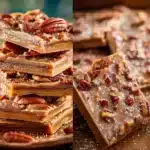
Pecan Pie Bark
- Total Time: 30 minutes
- Yield: 20 servings 1x
- Diet: Vegetarian
Description
This Pecan Pie Bark combines crunchy graham crackers with a buttery caramel coated in toasted pecans, making it a perfect sweet treat for any occasion.
Ingredients
- 10 sheets graham crackers
- 1 cup unsalted butter
- 1 cup brown sugar
- 1/2 cup granulated sugar
- 1/2 cup corn syrup
- 1 tsp ground cinnamon
- 1/4 tsp salt
- 1 cup chopped pecans
- 1 tsp vanilla extract
- Optional: 1 cup dark chocolate, chopped
Instructions
- Preheat the oven to 350°F and line a quarter sheet pan or 9×13 baking dish with parchment paper.
- Arrange the graham crackers in a single layer, covering the entire surface.
- In a saucepan, melt the butter, brown sugar, granulated sugar, corn syrup, cinnamon, and salt over medium heat. Bring to a rolling boil and cook for 2 minutes, stirring constantly.
- Remove from heat and stir in the pecans and vanilla extract.
- Pour the caramel mixture evenly over the graham crackers and spread gently with a spatula.
- Bake for 10 minutes, or until the caramel is bubbly.
- Let cool completely, then break into pieces.
Notes
For a chocolate finish, immediately after baking, sprinkle chopped chocolate over the caramel and let it melt, then smooth with a spatula.
- Prep Time: 15 minutes
- Cook Time: 15 minutes
- Category: Dessert
- Method: Baking
- Cuisine: American
Nutrition
- Serving Size: 1 piece
- Calories: 200
- Sugar: 10g
- Sodium: 200mg
- Fat: 10g
- Saturated Fat: 5g
- Unsaturated Fat: 4g
- Trans Fat: 0g
- Carbohydrates: 30g
- Fiber: 1g
- Protein: 2g
- Cholesterol: 30mg