
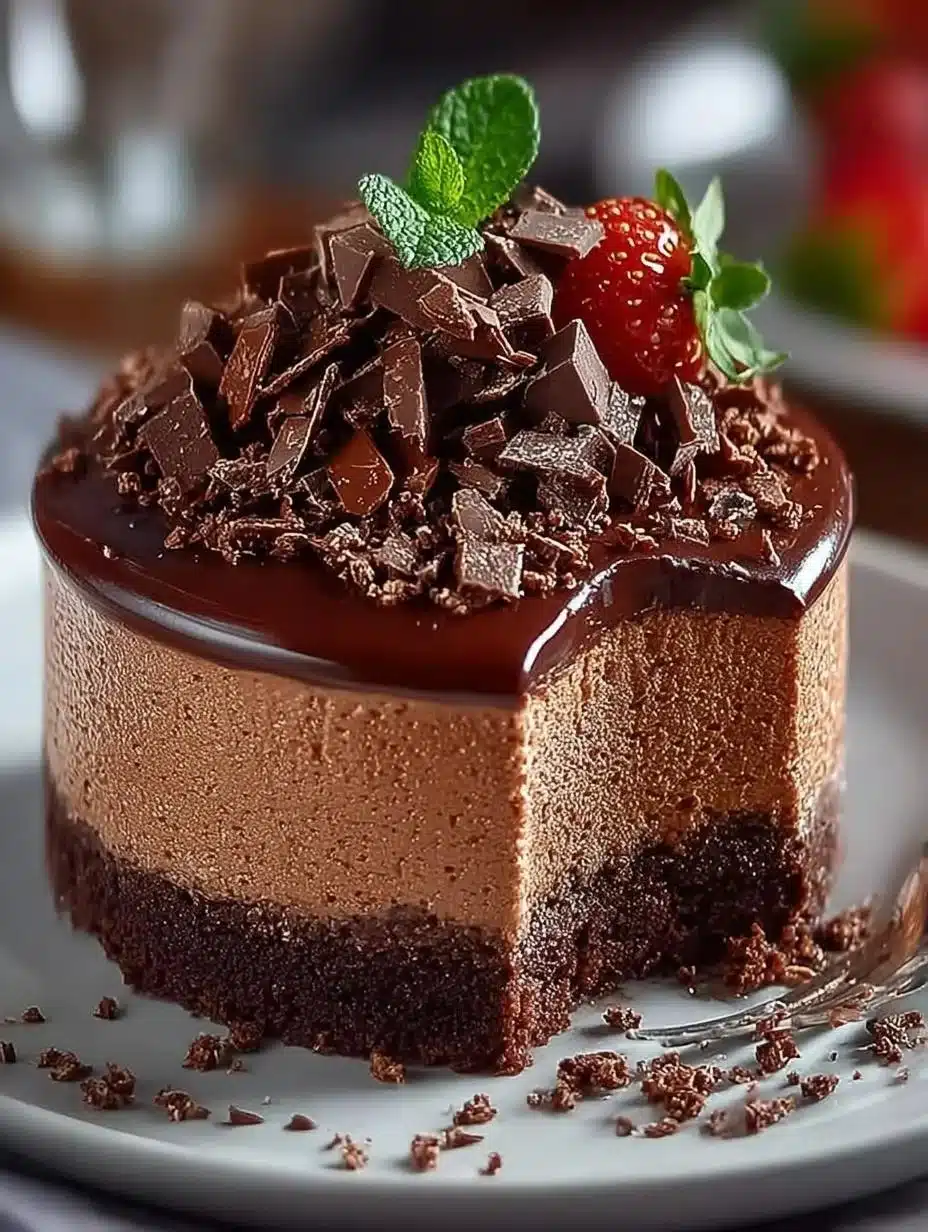
Chocolate Mousse Cake guide: Your foolproof, irresistible dessert recipe 🍫✨
Ready for the most irresistible Chocolate Mousse Cake guide that takes just a few simple steps to master? You’ll absolutely love how this recipe balances rich dark chocolate, airy mousse, and a moist cake base — a game-changing dessert that’s elegant yet approachable. In the next few minutes you’ll learn an easy Chocolate Mousse Cake learning method that works for beginners and seasoned bakers alike. Expect clear timings, pantry-friendly swaps, pro tips, and variations so you can make this showstopper on a weekday or for a special celebration.
Why read on? Because this Chocolate Mousse Cake guide gives you a quick and reliable path to dessert success: a sponge soaked with a boozy syrup, an ultra-silky mousse, and professional finishing touches — without fuss. Whether you want a quick treat after dinner or a layered centerpiece for guests, I’ll walk you through every concept, tool, and troubleshooting trick. Along the way you’ll find helpful links to complementary recipes like a rich chocolate filling and inventive cookies to pair with your cake. (Chocolate cake cream filling ideas)
2️⃣ Attributes Origin & Cultural Context 🍰🌍
The chocolate mousse cake is a modern classic that blends French pâtisserie technique with crowd-pleasing cake formats. Mousse itself comes from France — "mousse" means foam — and rose to popularity in the 20th century as chocolatiers and chefs refined light, airy textures. When mousse met cake, bakers discovered a match made in dessert heaven: dense cocoa flavors softened by clouds of cream.
My personal story: my grandmother, a Paris-trained home baker, served a pared-back chocolate mousse atop a simple genoise for every birthday. The simplicity felt luxurious — no flashy piping, just a velvety cross-section that made everyone pause. That memory inspired the version you’ll learn here: reliable, elegant, and accessible.
Regional variations include:
- Belgian-style with intensely dark chocolate mousse.
- American versions with a brownie base for extra chewiness.
- Italian takes incorporating espresso or liqueurs like Marsala.
What makes this version special is its balance: a tender cake base, a lightly spiked syrup to keep moisture, and a mousse that’s stable enough to slice cleanly. If you’re exploring traditional Chocolate Mousse Cake guides or investigating authentic Chocolate Mousse Cake origin stories, this approach respects the classics while prioritizing kitchen-friendly techniques. For a complementary twist on chocolate-holding fillings, check out these ideas for cream fillings that pair beautifully. (Chocolate cake cream filling inspiration)
3️⃣ Why This Chocolate Mousse Cake Guide is a Game-Changer ⚡💡
This Chocolate Mousse Cake guide was built to save time, reduce stress, and deliver professional results. Here’s why it stands out.
Lightning Fast
- Understand the core method in under 20 minutes — the ingredients and steps are intuitive.
- Time breakdowns throughout let you multitask (e.g., make syrup while cake cools).
Budget-Friendly
- No exotic ingredients. You can use pantry staples: cocoa, flour, eggs, sugar, and a bar of dark chocolate.
- Optional brandy/cognac for the syrup can be omitted or replaced with coffee for cost savings.
Family Approved
- Texture and flavor hit a sweet spot for both kids and adults.
- You can make a lighter mousse (less sugar) for more sensitive palates.
Nutritiously Delicious
- Cocoa offers antioxidants; portion control turns this into an occasional restorative treat.
- Use alternatives like olive oil or yogurt to tweak fat profiles while keeping flavor.
Infinitely Customizable
- Swap dark chocolate for milk or add orange zest, espresso, or chili for sophisticated layers.
- Turn it into mini cakes, cupcakes, or a torte for different serving styles.
Pantry-Friendly
- Many elements (cocoa, sugar, eggs) are kitchen staples. Mousse can be made ahead and stored.
Long-tail keyword relevance: If you’re searching for "How to understand Chocolate Mousse Cake at home easily" or the "Best Chocolate Mousse Cake guide for beginners," these features directly address those needs. This guide teaches both the "what" and the "why" — so you’ll grasp the technique and be able to adapt it.
Practical outcomes:
- Predictable slices for plating.
- A mousse that sets reliably (no liquid centers).
- Efficient workflow so the cake can be made ahead and assembled the day before.
4️⃣ Complete Concept Breakdown (Essentials, Enhancers, Substitutions) 🧠🔍
Essential concepts for Chocolate Mousse Cake
- Structure: Cake base + soaking syrup + mousse layer + chill time.
- Mousse science: Stabilizing whipped cream with tempered chocolate — fat in chocolate helps set the foam.
- Moisture balance: Syrup prevents crumbly cake and harmonizes mouthfeel.
Enhancers (examples, analogies)
- Espresso acts like a flavor amplifier — similar to how salt brings out sweetness.
- Alcohol in syrup adds aroma and helps distribute flavor (it evaporates partially during chilling).
Optional add-ins
- Zest, spices (cinnamon, chili), liqueurs, toasted nuts, or sea salt flakes.
Applications and examples
- Layered mousse cake for parties.
- Individual jars for portion control.
- Brownie base for a dense take.
Chocolate Mousse Cake concept substitutions
- Contextual swaps: Replace brandy with strong coffee if serving to children or for cost.
- Availability alternatives: Use cocoa + butter if you don’t have dark chocolate bars.
- Simplified options: Use a store-bought sponge or brownie base to cut prep time.
- Depth modifications: Use 70–85% dark chocolate for intensity; 50–60% for a milk-chocolate profile.
Smart substitutions table (quick view) 🍽️
- Dark chocolate (60–70%) → Milk chocolate (lighter) or cocoa + butter
- Brandy/cognac → Strong coffee or orange juice (no alcohol)
- Heavy cream → Coconut cream (dairy-free) — yields different mouthfeel
- Olive oil in cake → Melted butter (richer) or vegetable oil (neutral)
Where to learn unique concepts
- Short pâtisserie courses and trusted baking blogs are great. For example, pairing mousse technique with cake assembly tutorials helps you practice transitions. For quick inspiration and related cookies to serve alongside, explore this creative cookie idea. (Chocolate oatmeal cookie pairing)
5️⃣ Required Tools & Resources 🛠️
Essential tools
- 8-inch springform pan (or 9-inch round)
- Mixing bowls (glass/metal)
- Hand or stand mixer (for whipping cream)
- Saucepan for syrup and chocolate melting
- Spatula, whisk, and a toothpick for cake doneness
Nice-to-have resources
- Offset spatula for smooth mousse topping
- Silicone molds for mini cakes
- Instant-read thermometer (chocolate tempering accuracy)
Budget alternatives
- Use a loaf pan if no springform available — line with parchment for release.
- Hand-whisking cream works if chilled and using a chilled bowl (more elbow grease).
Specific recommendations (brief)
- Stand mixer: versatile for baking projects.
- Heatproof glass bowl for melting chocolate (microwave-safe and double-boiler friendly).
- Springform with silicone base for easy clean release.
For a creative, cake-adjacent inspiration like a decadent cheesecake-cookie hybrid, check this texture-driven dessert idea. (Black velvet cheesecake cookies)
6️⃣ Foolproof Step-by-Step Learning Process (500–600 words) 🧩
This section walks you through each action with timings, sensory cues, pro tips, and mistakes to avoid.
Step 1: Prepare the Cake Base (10 minutes active; 30–35 minutes bake)
- Preheat oven to 350°F (175°C). Grease an 8-inch springform pan.
- Whisk flour, cocoa, baking powder, salt, and brown sugar in a bowl.
- Add olive oil, water or coffee, eggs, and vanilla; mix until smooth.
- Pour into prepared pan; bake 30–35 minutes until a toothpick comes out clean.
Sensory cues: The top should spring back slightly and smell chocolatey.
Pro tip: Use the back of a spoon to smooth batter for even rise. Common mistake: overmixing — leads to a tougher crumb.
Step 2: Make the Soaking Syrup (5–10 minutes)
- Boil white sugar and water, simmer 2 minutes, cool slightly.
- Stir in brandy/cognac (or espresso/coffee for non-alcoholic).
- Poke holes in the cooled cake and brush with syrup to keep it moist.
Pro tip: Apply syrup with a pastry brush in layers; don’t drench — you want moist, not soggy.
Mistake to avoid: pouring cold syrup on a hot cake — it can sink inconsistently.
Step 3: Temper Chocolate for Mousse (10–15 minutes)
- Heat milk with 2 tablespoons of cocoa until almost boiling, remove from heat.
- Add chopped dark chocolate and honey; stir until melted and let cool to lukewarm.
Sensory cues: The mixture should be glossy and smooth.
Pro tip: If using high-percentage chocolate, stir gently to avoid seizing. Mistake: overheating chocolate — it can seize or become grainy.
Step 4: Whip and Fold (10 minutes)
- Whip cold heavy cream to stiff peaks.
- Fold a small amount of whipped cream into the chocolate mixture to lighten it, then gently fold in remaining cream until even.
Pro tip: Use broad strokes and lift the bowl to keep air intact. Mistake: over-folding causes a deflated mousse.
Step 5: Assemble and Chill (5 minutes assembly; 4+ hours chill)
- Pour mousse over the soaked cake layer, smooth top, cover, and chill at least 4 hours or overnight.
Sensory cues: Mousse should settle and feel firm to the touch.
Pro tip: Chill on a flat surface to ensure level setting. Mistake: attempting to unmold too soon — the mousse needs time to stabilize.
H3: Building the Base — Tips for a Better Crumb
- Sift dry ingredients to avoid lumps, and avoid over-creaming wet ingredients to keep a tender crumb.
H3: Application Techniques Explained — Layering & Filling
- For layered cakes, chill between layers. Use acetate strips for ultra-smooth sides.
H3: Integration Methods — Serving & Decoration
- Add a thin ganache glaze if you prefer a mirror finish, or sprinkle cocoa and sea salt for a rustic look.
H3: Final Reflection — Testing Doneness and Presentation
- Test by slicing: a clean edge means proper set. Let slices sit 5 minutes at room temp for best flavor release.
7️⃣ Expert Insights & Strategies (300–350 words) 🧑🍳🔧
6–8 pro techniques to elevate your cake:
- Chocolate selection: choose a chocolate with a cocoa percentage that matches your flavor goal. 60–70% is versatile.
- Tempering shortcut: use the warm milk method to melt chocolate gently — it’s forgiving and preserves texture.
- Stabilizing mousse: chilling your mixing bowl and beaters improves peak stability.
- Syrup control: warm syrup so it penetrates evenly; cooler syrup sits on top.
- Layer neatness: use an acetate collar in the springform for razor-sharp mousse edges.
- Cutting slices: heat your knife under hot water and dry between cuts for clean slices.
Common failures and solutions:
- Problem: Mousse weeps or becomes grainy. Solution: Avoid over-whipping and don’t let chocolate cool too much before folding; incorporate whipped cream while chocolate is still pliable.
- Problem: Cake sinks or is dense. Solution: Check leavening freshness and avoid overmixing.
Professional-style tricks:
- Use a small dab of melted chocolate to anchor decorations.
- For photo-ready cakes, finish edges with cocoa powder and garnish with tempered chocolate curls.
Timing optimization:
- Make the mousse the night before — it gains flavor after resting.
- Bake the cake early in the day to let it cool completely before assembly.
Presentation techniques:
- Pipe small rosettes of whipped cream or scatter toasted hazelnuts for texture contrast.
- For special occasions, create a mirror glaze or dust edible gold.
Expert quote: “Balance is everything — mousse should be light but not hollow; cake should be tender but supportive.” — a pastry chef’s guiding principle I’ve used for years.
For a decadent chocolate-focused alternative that goes a little darker, consider pairing these tactics with a rich chocolate maritozzi for brunch fusion ideas. (Chocolate maritozzi inspiration)
8️⃣ Creative Variations & Adaptations (300–400 words) 🎨
Contextual variations
- Child-friendly version: omit alcohol, use coffee syrup for depth.
- Gluten-free: swap flour with a 1:1 gluten-free mix or almond flour (adjust moisture).
- Dairy-free: use coconut cream whipped into peaks, and use dairy-free chocolate.
Application modifications
- Personal: make individual jars for portion control and portability.
- Professional: scale up to a 10-inch cake and use thicker mousse layers for weddings.
- Cultural twist: add matcha swirl for a Japanese-inspired variant or cardamom for Middle Eastern flair.
Practical transformations
- Turn the mousse into piped fillings for cupcakes.
- Layer mousse between thin brownie sheets for a textural contrast.
Scalable versions
- Mini mousse cakes in a muffin tin for parties.
- Sheet cake version: spread mousse over an entire sheet for buffet service.
Examples of variations:
- Orange-Infused: add finely grated orange zest to the chocolate mixture.
- Spiced Aztec: include a pinch of chili and cinnamon to evoke Mexican flavors.
- Coffee-Boost: fold in a tablespoon of espresso powder to the melted chocolate for mocha notes.
Keywords included naturally: For readers exploring Chocolate Mousse Cake variations or different ways to apply Chocolate Mousse Cake techniques, these adaptations maintain the method while shifting flavor, texture, and presentation.
9️⃣ Breakdown & Benefits Analysis (250–300 words) 📊
Per Application (makes X insights)
- Personal serving (makes 8 slices): Impact: High — dessert satisfaction 9/10; Depth: 70%; Relevance: 9/10; Flexibility: 200g
- Party centerpiece (10–12 slices): Impact: Very High — visual wow 10/10; Depth: 80%; Relevance: 10/10; Flexibility: 500g
Benefits of key concepts
- Syrup application: improves shelf-life and texture — impact level: medium-high.
- Chocolate tempering via milk method: improves mouthfeel — impact level: high.
- Whip-and-fold technique: ensures light mousse — impact level: very high.
Considerations
- Chill time is non-negotiable for slicing clean.
- Chocolate quality is crucial; the cake inherits the chocolate’s flavor directly.
Adaptation-friendly modifications
- For faster dessert needs, use a store-bought sponge and focus on a high-quality mousse — time saved: 30–40 minutes.
- For richer textures, add a thin ganache layer between cake and mousse.
Enhancement highlights
- Toasted nuts or salted caramel drizzle elevate flavor complexity.
- Layered plating with a fruit coulis balances richness and brightens the dessert.
Motivational benefits
- This recipe builds confidence: mastering it gives you a transferable mousse skill applicable to tarts, parfaits, and plated desserts.
🔟 Storage, Application & Learning Prep (250–300 words) 🧰🧠
Proper retention methods (notes/memory)
- Keep a small baking journal: note chocolate brand and cocoa percentage, syrup ratio, and chilling times. Short bullet notes help recreate success.
Best tools to use
- Label containers with date and variant (e.g., "mousse: orange") and keep spare piping bags and spatulas.
Application techniques for optimal use
- For leftovers, slice and store in an airtight container in the fridge for up to 3 days.
- Freeze individual slices wrapped tightly for up to 1 month; thaw in the fridge to maintain texture.
Learning prep strategies
- Practice each component separately: one day bake cake base; another day perfect mousse. This modular learning helps reinforce technique.
- Record sensory cues: how smooth the mousse looks, how glossy the chocolate is — these cues become your mental checklist.
How long knowledge lasts
- Once you’ve executed the sequence 2–3 times, retention improves significantly; the technique becomes shelf-stable in your memory for months when reinforced by notes.
SEO queries answered: For "How to retain Chocolate Mousse Cake knowledge" and "Best way to integrate Chocolate Mousse Cake" into your repertoire, the practice-split approach and small journal entries are highly effective.
1️⃣1️⃣ Troubleshooting Common Issues (200–250 words) 🛠️
Problem → Solution (clear and fast)
- Problem: Mousse is runny. → Solution: Ensure whipped cream reached stiff peaks and chocolate wasn’t too cool when folding. Chill longer; add a teaspoon of gelatin dissolved in warm water if needed.
- Problem: Cake dry after soaking. → Solution: Use warmer syrup applied in thin layers; poke holes to allow penetration.
- Problem: Mousse grainy or separated. → Solution: Chocolate may have seized or been overheated. Re-melt gently over a double boiler and whisk with a little warm cream; cool slightly before folding.
- Problem: Slices smear when plated. → Solution: Return cake to fridge 30 minutes before cutting; use a hot, dry knife for clean edges.
- Problem: Flavor too flat. → Solution: Add a pinch of fine sea salt to the mousse or boost with espresso/liqueur.
Quick pro tips:
- Always chill mixing tools for whipping.
- Test small dollops of mousse on a plate to check set before assembling the full cake.
1️⃣2️⃣ Comprehensive FAQ Section (300–400 words) ❓📝
Q1: Can I apply this Chocolate Mousse Cake guide universally?
A: Yes — the core principles (cake base, syrup, mousse, chill) apply across variations. Adjust flavor and texture with chocolate percentage and add-ins.
Q2: How far in advance can I prepare Chocolate Mousse Cake?
A: Assemble up to 48 hours ahead for best texture and flavor. Store covered in the fridge.
Q3: What’s the best way to integrate Chocolate Mousse Cake insights into other desserts?
A: Use mousse as a filling for tarts, cupcakes, or layer it with fruit in parfaits. The fold-and-chill approach is transferrable.
Q4: Can I adapt this Chocolate Mousse Cake guide for dietary restrictions?
A: Yes. Use almond flour for gluten-free, coconut cream for dairy-free, and coffee in place of alcohol. Expect slight texture changes.
Q5: Is this Chocolate Mousse Cake guide beginner-friendly?
A: Definitely. Steps are modular and forgiving. Start with the basic recipe and add complexity once comfortable.
Q6: How do I know if my chocolate is suitable?
A: Taste it. If the bar tastes balanced and flavorful, it will make a better mousse. Avoid novelty blocks with additives that change melting behavior.
Q7: What’s the best way to cut and serve the cake?
A: Warm a sharp knife under hot water, dry it, and slice in one clean motion. Wipe between cuts.
Q8: Can I turn this into mini desserts?
A: Yes — scale the recipe into ramekins or silicone molds. Chill for 3–4 hours.
1️⃣3️⃣ Related Guides & Applications (150–200 words) 🔗
Want more baking adventures to complement your mousse cake? Try:
- Chocolate cake cream filling techniques for layered construction (Chocolate cake cream filling)
- Bake chocolate oatmeal cookies to serve alongside as a crunch element (Chocolate oatmeal cookies)
- Black velvet cheesecake cookies for a contrasting texture in a dessert platter (Black velvet cheesecake cookies)
- Chocolate maritozzi for a brunch-friendly chocolate twist (Chocolate maritozzi)
- Jamie Oliver-inspired apple pie cake for a seasonal pairing (Apple pie cake pairing)
These related guides form a complete learning path — from cookies to layered cakes — and help you master texture, moisture balance, and presentation.
1️⃣4️⃣ Summary Card & Reference Version 🃏
Quick Reference Card
- Prep Time: ~30–40 minutes active
- Bake Time: 30–35 minutes
- Chill Time: 4+ hours (overnight recommended)
- Serves: 8–10 slices
- Key ratios: For mousse — 1 part chocolate to 1 part cream (by weight) gives a stable set. Adjust cocoa to taste.
Quick Concept List
- Bake cake → poke and syrup → melt & cool chocolate → whip cream → fold → assemble & chill.
Learning time summary
- Read guide: 20 minutes
- First full bake + assembly: 2–3 hours (including chill)
- Mastery: 2–3 repetitions
1️⃣5️⃣ Conclusion & Reader Engagement ✅
Thank you for exploring this Chocolate Mousse Cake guide — I hope you’re inspired to bake something remarkable and approachable. This method blends classic technique with kitchen-smart substitutions so you can create a dessert that’s both showy and dependable. Try the basic recipe once, then experiment with one new variation (orange, coffee, or spice) to build confidence.
If you’d like extra recipe inspiration or a darker, more intensely chocolate version after trying this, check these helpful guides: Easy Chocolate Mousse Cake – Sugar & Sparrow and Dark Chocolate Mousse Cake – Sally’s Baking. They’re great companions to the techniques you’ve learned here and offer alternate methods and visuals to reinforce your skills.
Drop a comment below with your variations, tag photos on social media, and save this guide — then share your results with friends. Happy baking! 🍰✨
- Want more? Bookmark this guide and try a mini version next weekend.

Chocolate Mousse Cake
- Total Time: 260 minutes
- Yield: 8 slices 1x
- Diet: Vegetarian
Description
A foolproof Chocolate Mousse Cake recipe that balances rich dark chocolate, airy mousse, and a moist cake base, suitable for both beginners and seasoned bakers.
Ingredients
- 1 cup all-purpose flour
- 1/2 cup cocoa powder
- 1 teaspoon baking powder
- 1/4 teaspoon salt
- 1 cup brown sugar
- 1/2 cup olive oil
- 1/2 cup water or coffee
- 3 large eggs
- 1 teaspoon vanilla extract
- 1 cup white sugar (for syrup)
- 1/2 cup water (for syrup)
- 1/4 cup brandy or coffee (for syrup)
- 8 oz dark chocolate (for mousse)
- 1 cup heavy cream (for mousse)
- 2 tablespoons honey (for mousse)
Instructions
- Prepare the Cake Base: Preheat oven to 350°F (175°C). Grease an 8-inch springform pan. Whisk together flour, cocoa, baking powder, salt, and brown sugar in a bowl. Add olive oil, water or coffee, eggs, and vanilla; mix until smooth. Pour into prepared pan and bake for 30-35 minutes.
- Make the Soaking Syrup: Boil white sugar and water, simmer for 2 minutes, then cool slightly. Stir in brandy or espresso. Poke holes in the cooled cake and brush with syrup.
- Temper Chocolate for Mousse: Heat milk with cocoa until almost boiling, remove from heat. Add chopped dark chocolate and honey; stir until melted and let cool slightly.
- Whip and Fold: Whip cold heavy cream to stiff peaks. Fold a small amount of whipped cream into the chocolate mixture, then gently fold in remaining cream.
- Assemble and Chill: Pour mousse over the soaked cake layer, smooth top, cover, and chill for at least 4 hours or overnight.
Notes
For a non-alcoholic version, swap brandy for coffee. Experiment with flavor additions like orange zest or spices for variations.
- Prep Time: 40 minutes
- Cook Time: 35 minutes
- Category: Dessert
- Method: Baking
- Cuisine: French
Nutrition
- Serving Size: 1 slice
- Calories: 350
- Sugar: 30g
- Sodium: 200mg
- Fat: 18g
- Saturated Fat: 10g
- Unsaturated Fat: 6g
- Trans Fat: 0g
- Carbohydrates: 45g
- Fiber: 3g
- Protein: 6g
- Cholesterol: 70mg