
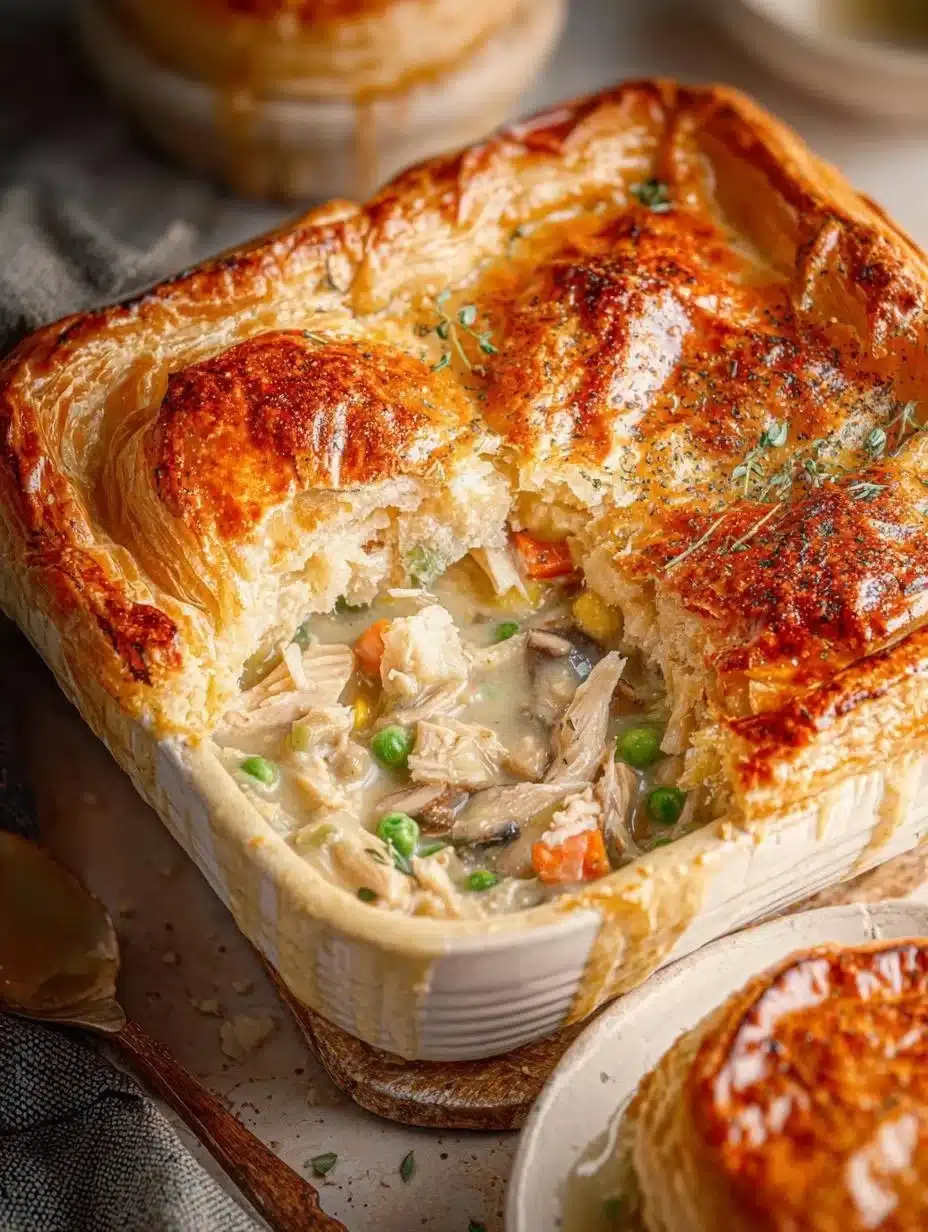
Chicken Pot Pie Casserole guide: The ultimate, foolproof casserole you’ll love 🍽️
Ready for a Chicken Pot Pie Casserole guide that will become your new obsession? You’ll absolutely love this easy, budget-friendly, and family-approved approach to a classic comfort dish. In the next few minutes you’ll learn how to turn pantry staples into an irresistible, flaky-topped casserole that feeds a crowd or makes perfect leftovers. This guide focuses on practical steps, smart substitutions, and pro tips so even beginners feel confident. Expect clear timing, sensory cues, and solutions for common problems — plus a few personal stories and expert insights to help you master the dish. If you enjoy hearty casseroles, also check this cozy take on a breakfast-for-dinner favorite: Denver omelette hashbrown casserole.
Attributes Origin & Cultural Context 🌍
Chicken pot pie in casserole form is comfort food with roots in frugality and seasonal cooking. Traditional pot pie traces back to medieval Europe where meat and vegetables were enclosed in pastry to preserve and transport ingredients. The casserole adaptation — a shallow baking dish with a single crust — became popular in American kitchens when home cooks sought simpler, faster ways to feed families with one-dish meals.
My grandmother taught me a version of this casserole after a long day of teaching; she’d say, “It’s about warmth, not perfection.” Her patchwork of leftover chicken, potatoes, and frozen vegetables made it a weeknight hero. What makes this version special is the shortcut: a creamy stovetop filling that’s thickened with a sprinkle of flour, finished under a golden puff pastry top. It’s a balance of convenience and tradition that works across regions — from New England’s hearty comforts to Southern-style casseroles with biscuit tops.
For a twist on savory chicken dinners to pair with this pot pie vibe, consider trying a tangy skillet option like this Creamy Pepperoncini Chicken Skillet for nights when you want quick stovetop comfort.
Why This Chicken Pot Pie Casserole Guide is a Game-Changer ⚡✨
This Chicken Pot Pie Casserole guide was built to remove guesswork and save time without sacrificing flavor. Here’s why it stands apart:
Lightning Fast: With the method below you’ll have a complete casserole ready to bake in about 25–35 minutes of hands-on time and then 25–28 minutes in the oven. The stovetop filling cooks quickly so you don’t wait hours. This is perfect for busy weeknights.
Budget-Friendly: Uses pantry staples — potatoes, frozen mixed vegetables, chicken (leftover or cooked fresh), broth, and pantry spices. No specialty ingredients required; you can swap proteins or veggies depending on what’s on hand.
Family Approved: The textures and flavors are widely appealing — creamy filling, flaky top, and familiar savory seasonings. It’s a great dish for picky eaters and for introducing kids to cooking basics.
Nutritiously Delicious: While indulgent, you can boost nutrition simply: use half-and-half or milk instead of heavy cream, add more veg, or fold in greens after baking. Comfort food can support mental well-being through shared meals and sensory satisfaction.
Infinitely Customizable: Want a lower-carb version? Swap the puff pastry for mashed cauliflower or a biscuit top. Vegetarian? Use mushrooms and beans. Make it spicy? Add smoked paprika or chiles.
Pantry-Friendly: Flour, broth, and puff pastry are often on hand. The method’s flexibility lets you adapt without extra shopping.
Long-tail intents this guide covers well include how to understand Chicken Pot Pie Casserole at home easily, best Chicken Pot Pie Casserole guide for beginners, and quick Chicken Pot Pie Casserole learning method. The clear timings and sensory cues cut learning friction — you’ll feel confident after the first bake.
Complete Concept Breakdown (Essentials, Enhancers, Substitutions) 🧠
Essential base concepts:
- Thickened roux-style filling: flour toasted briefly in butter or fat gives body and prevents a thin, runny filling.
- Proper seasoning: salt, pepper, thyme, and a touch of oregano bring balance.
- Evenly-sized vegetables: cubes of potato and bite-sized carrots/peas ensure consistent cooking.
- Puff pastry finish: gives crisp, golden contrast; brush with egg for shine.
Enhancers (examples, analogies):
- A splash of white wine or a spoonful of Dijon adds brightness like a citrus squeeze on a salad.
- A handful of sharp cheddar melted into the filling lends depth (think of it as the “bass line” under the melody of herbs).
- Fresh tarragon or parsley at the end lifts the dish like a finishing perfume.
Optional add-ins:
- Bacon or pancetta for smokiness.
- Mushrooms for umami depth.
- Frozen corn for sweetness and color.
- A dollop of creme fraiche or sour cream for tang.
Applications and examples:
- Weeknight dinner: quick stovetop, top with pastry, bake.
- Potluck: assemble in advance, refrigerate, bake before serving.
- Meal prep: portion into smaller ramekins and freeze; bake from frozen adding extra time.
Smart substitutions table (quick visual):
- Puff pastry → Biscuits or phyllo (flaky but thinner) 🥐
- Half-and-half → Milk + a spoon of butter (lighter) 🥛
- Fresh chicken → Rotisserie or canned (convenient) 🍗
- Flour → Cornstarch (use less, mix with cold liquid) 🌽
- Mixed frozen veg → Fresh seasonal veg (roasting first) 🥕🍃
Where to learn specific techniques: seek basic roux and pastry handling tutorials — short videos help more than text for feel and timing. If you like varied casserole inspiration, this garlic-butter roast technique pairs well before baking: Garlic Butter Baked Chicken.
Required Tools & Resources (Quick List) 🧰
Essential tools:
- 10×7 or 9×13 inch baking dish (depth matters for filling balance)
- Large skillet (10–12 inch) with lid for simmering filling
- Rolling pin (for puff pastry) or use your hands for biscuit dough
- Pastry brush for egg wash
- Rubber spatula and wooden spoon
Nice-to-have:
- Instant-read thermometer (to check internal temperature if using raw chicken)
- Bench scraper for neat pastry work
- Fine-mesh strainer (for smooth gravy if desired)
Budget alternatives:
- Use a cast-iron skillet (oven-safe) as both stovetop and baking vessel.
- Rolling pin substitute: a wine bottle wrapped in a towel.
- Puff pastry alternative: canned biscuits or a sheet of phyllo brushed with butter.
Specific recommendation: a nonstick skillet that tolerates oven temps up to 400°F makes transfer effortless. For beginners, a frozen puff pastry sheet from a reliable brand gives great results with minimal handling.
Foolproof Step-by-Step Learning Process (Detailed, 500–600 words) 🔧👩🍳
Step 1: Preheat & Prep (5 minutes)
- Preheat oven to 375°F. Spray or butter your baking dish and set aside.
- Pro tip: Preheating ensures puff pastry puffs properly; a cold oven yields a denser crust.
- Common mistake: skipping preheat — pastry won’t rise well.
Step 2: Cook the Chicken (6–8 minutes)
- In a skillet, add a tablespoon of olive oil and cook seasoned chicken (salt & pepper) over medium-high heat about 3 minutes per side for bite-sized pieces, or until cooked through.
- If using cooked chicken, warm it briefly in the pan at the end.
- Pro tip: Save pan juices — they add flavor to the filling.
Step 3: Sauté Veggies (4–5 minutes)
- Add chopped onion, potatoes, and 1–2 tbsp butter; sauté for 3–4 minutes until starting to soften.
- Add garlic and cook 1 minute until fragrant.
- Visual cue: onions should be translucent, potatoes slightly picking up color.
- Common mistake: overcrowding pan — work in batches if needed.
Step 4: Build the Sauce (5–6 minutes)
- Add 2 cups of broth, thyme, oregano, and a bouillon cube or seasoning; bring to simmer for 4–5 minutes.
- Sprinkle 2–3 tbsp flour over mixture and stir for 1 minute to cook the raw flour taste.
- Slowly stir in half-and-half (or milk + extra butter) and add frozen veggies; simmer 3 minutes until slightly thickened.
- Pro tip: If filling looks too thin, mix 1 tsp cornstarch with cold water and stir in; if too thick, add splash of broth.
Step 5: Taste & Adjust (2 minutes)
- Taste for salt and pepper; adjust. Add a pinch of nutmeg if you like warmth.
- Sensory cue: sauce should coat the back of a spoon, not run off.
Step 6: Assemble the Casserole (5 minutes)
- Transfer filling to the prepared baking dish, spreading evenly.
- Unroll puff pastry and roll to fit dish; place on top, crimp edges, and score the top to vent.
- Brush pastry with beaten egg for golden shine.
- Pro tip: Chill pastry briefly if it feels too soft; cold pastry puffs better.
Step 7: Bake (25–28 minutes)
- Bake at 375°F for 25–28 minutes until pastry is golden brown and filling bubbles at edges.
- Visual cue: golden, flaky top and bubbling sides.
- Common mistake: under-baking — ensure pastry is set and top is browned.
Step 8: Rest & Serve (5–10 minutes)
- Let the casserole rest before cutting to allow filling to set.
- Serve with a crisp salad or roasted vegetables.
H3: Building the Base
- Focus on even sautéing and careful thickening. A proper base starts with good fond (browned bits) and a well-cooked flour stage.
H3: Application Techniques Explained
- For leftovers: cool completely, cover, and refrigerate up to 3 days. Reheat covered at 350°F for 20–30 minutes.
- For make-ahead: assemble unbaked, cover tightly, refrigerate up to 24 hours, bake directly from chilled adding 5–10 minutes.
H3: Integration Methods
- To introduce new flavors, integrate small amounts (1–2 tbsp) of strong agents — Dijon, Worcestershire, or soy sauce — to avoid overpowering.
H3: Final Reflection
- After your first bake, note one tweak to try next time: more herbs, different veg, or a cheese addition. This iterative approach ensures rapid improvement.
Expert Insights & Strategies (Pro-level tips) 🧑⚕️🔍
- Flavor layering: Season at each stage — raw chicken, vegetables, then sauce — to build complex taste.
- Texture control: Use a mix of potato and smaller veggies for contrast; parboil big potato cubes if you prefer faster cook times.
- Sauce consistency trick: For a silky finish, whisk half the liquid into the flour off-heat before adding to the pan; this avoids lumps.
- Timing optimization: If puff pastry browns too quickly, tent with foil and finish baking until filling bubbles.
- Presentation technique: Brush the pastry with milk for a matte finish or with egg yolk for deeper shine.
- Troubleshooting failures: If pastry becomes soggy, bake uncovered on a lower oven rack to crisp the bottom.
- Integration timing: Add delicate greens (spinach, kale) last minute after baking for color and freshness.
- Make it ahead like pros: Freeze individual portions after baking; reheat in oven (not microwave) for best crust.
Common failures and solutions:
- Runny filling → Cook longer or add slurry (cornstarch + cold water).
- Soggy bottom → Bake on a preheated sheet pan for better heat conduction.
- Bland taste → Finish with acid (lemon or splash of vinegar) to brighten.
Creative Variations & Adaptations 🎨
Contextual variations:
- Southern-style: swap puff pastry for a buttermilk biscuit top and add smoked ham.
- Mediterranean twist: add roasted red peppers, oregano, and feta crumbles after baking.
- Low-carb: replace puff pastry with a cauliflower mash top or almond flour biscuits.
Application modifications:
- Personal: Add favorite cheese or chopped herbs.
- Professional/catering: Scale to hotel pans; par-bake the pastry and assemble on-site to maintain crispness.
Cultural twists:
- French: infuse sauce with white wine and tarragon.
- Indian-inspired: swap thyme for garam masala and add peas, carrots, and a yogurt swirl.
Practical transformations:
- Meal-prep bowls: portion into small oven-safe containers and freeze for single servings.
- Party bites: use puff pastry cut into rounds and bake as mini pot pies.
Scalable versions:
- Double the stovetop base easily — use a large stockpot.
- For feeding a crowd, bake in sheet trays and cover with large sheets of pastry or a lattice.
Keywords included: Chicken Pot Pie Casserole variations, different ways to apply Chicken Pot Pie Casserole, customizable Chicken Pot Pie Casserole guide.
Breakdown & Benefits Analysis 📊
Per Application (makes 6–8 servings):
- Impact: High comfort factor, family satisfaction 9/10
- Depth: Medium (filling works as a full meal) 75%
- Relevance: 8/10 for weeknight dinners and potlucks
- Flexibility: 90g (metaphorically — highly adaptable)
Benefits of key concepts:
- Thickened filling: Keeps serving clean and hearty.
- Puff pastry: Adds texture contrast and visual appeal.
- Pantry-friendly ingredients: Low barrier to entry and low cost.
Considerations:
- Allergen note: Puff pastry typically contains gluten; use gluten-free pastry or biscuit alternative if needed.
- Time tradeoff: Hands-on time is minimal, but baking adds 25–28 minutes.
Adaptation-friendly modifications:
- Vegetarian: swap chicken for chickpeas and mushrooms.
- Protein-rich: fold in shredded rotisserie chicken or turkey for leftover makeovers.
Enhancement highlights:
- Add fresh herbs after baking to preserve brightness.
- Serve with acid-forward side like pickled red onions or citrus salad for balance.
Inclusive applications:
- Kid-friendly: mild seasoning and mashed-potato topping.
- Advanced cooks: experiment with layered fillings and pastry decorations.
Storage, Application & Learning Prep 🧠💾
Proper retention methods:
- Take notes after each bake: timing, seasoning, and what you’d change next time.
- Photograph your casserole to compare appearance across attempts.
Best tools to use:
- Notebook or cooking app for quick recipe tweaks.
- Label containers with date and reheating instructions.
Application techniques for optimal use:
- To reheat from refrigerated: 350°F covered for 20–25 minutes, then uncover to crisp.
- To reheat from frozen: bake at 375°F for 45–60 minutes covered, then uncover last 15 minutes.
Learning prep strategies:
- Practice the roux technique with small batches to build confidence.
- Watch a 3–5 minute demo of handling puff pastry before your first bake.
How long knowledge lasts:
- Once learned, the technique generalizes: thickening sauces, flavor layering, and pastry handling are transferable skills.
SEO phrases: how to retain Chicken Pot Pie Casserole knowledge, can you apply Chicken Pot Pie Casserole long-term, best way to integrate Chicken Pot Pie Casserole.
Troubleshooting Common Issues (Problem → Solution) 🛠️
Problem: Filling is watery.
Solution: Simmer uncovered to reduce; stir in a cornstarch slurry (1 tsp cornstarch + 1 tbsp cold water) and cook 1–2 minutes.
Problem: Pastry is soggy on bottom.
Solution: Bake on a preheated baking sheet in the lower third of the oven. If already soggy, broil briefly on high while watching.
Problem: Filling tastes bland.
Solution: Finish with acid (1 tsp vinegar or squeeze of lemon) and adjust salt. Add a spoonful of Dijon or a dash of soy for umami.
Problem: Pastry browns too fast.
Solution: Tent with foil and continue baking until filling bubbles.
Problem: Vegetables undercooked.
Solution: Cut smaller or parboil potatoes for 5 minutes before sautéing.
Problem: Over-salted from broth.
Solution: Add unsalted starch (potato or cooked rice) to absorb excess salt, or add more dairy to dilute.
Comprehensive FAQ Section (6–8 Questions) ❓
Q1: Can I apply this Chicken Pot Pie Casserole guide universally?
A: Yes — the method is adaptable. Swap proteins/veggies to suit diet and palates. For vegetarian or gluten-free options, follow substitutions listed earlier.
Q2: How far in advance can I prepare for Chicken Pot Pie Casserole?
A: You can fully assemble the casserole up to 24 hours ahead, refrigerated. For longer prep, bake and freeze finished portions.
Q3: What’s the best way to integrate Chicken Pot Pie Casserole insights into meal planning?
A: Use the stovetop base as a template: plan proteins and veggies across the week and swap the topping based on time (puff pastry for nights you can bake, biscuits for quicker bakes).
Q4: Can I adapt this Chicken Pot Pie Casserole guide for dietary needs?
A: Absolutely. Use gluten-free flour or cornstarch and gluten-free pastry, or swap dairy for plant-based milks + butter alternatives.
Q5: Is this Chicken Pot Pie Casserole guide beginner-friendly?
A: Yes. The step-by-step approach with sensory cues and timing is aimed at beginners; start with the standard recipe and tweak after one or two bakes.
Q6: Can leftovers be safely frozen?
A: Yes — freeze individual portions after cooling. Reheat in a 350–375°F oven (covered) until warmed through, then uncover to crisp.
Q7: How do I prevent separation in the sauce?
A: Avoid boiling high for long periods; maintain a gentle simmer and finish with low heat once thickened.
Q8: What side dishes pair best?
A: Crisp salads, roasted root vegetables, or simple steamed greens balance richness. For more comforting pairings, try recipes like Chicken Bacon Ranch Pasta for a decadent side (or alternate main).
Related Guides & Applications 🔗
Complementary topics:
- Quick weeknight casseroles
- Leftover rotisserie chicken transforms
- Sauces and gravy fundamentals
Suggested pairings:
- Garlic-butter roasted chicken for a simpler roast alternative.
- Skillet sides or pasta dishes to round a buffet table.
Further resources:
- For crockpot flavor play, compare slow-cooked proteins like Crockpot Chicken Piccata.
- These guides form a complete learning path for home cooks wanting more one-dish meals and efficient weeknight strategies.
Summary Card & Reference Version 🃏
Quick concept list:
- Core: sauté onion + potatoes → add broth + herbs → thicken with flour → add half-and-half + veggies → assemble → top with puff pastry → bake 25–28 min.
- Hands-on time: ~30–40 minutes
- Oven time: 25–28 minutes
- Servings: 6–8
Learning time summary:
- First attempt: 60–75 minutes including resting.
- Repeat attempts: 45–60 minutes as you streamline prep.
Condensed tips:
- Preheat oven, keep pastry cold, taste at each stage, and rest before serving.
Conclusion ✅
You’ve just finished a complete Chicken Pot Pie Casserole guide that balances speed, flavor, and flexibility. Try the method as written once, take notes, then experiment with a variation — maybe a Mediterranean twist or a biscuit top. For inspiration and a similar comforting recipe, explore Cozy Chicken Pot Pie Casserole Recipe | The Kitchn (Cozy Chicken Pot Pie Casserole Recipe | The Kitchn), and for another homestyle casserole idea, see Chicken Pot Pie Casserole – CincyShopper (Chicken Pot Pie Casserole – CincyShopper).
Drop a comment below with your insights, tag your creation @yourhandle, and save this guide for your next cozy dinner. Happy baking — may your crust always be golden and your filling perfectly seasoned! 🧡
Print
Chicken Pot Pie Casserole
- Total Time: 58 minutes
- Yield: 6-8 servings 1x
- Diet: Comfort Food
Description
A comforting, family-approved chicken pot pie casserole with a flaky puff pastry top, perfect for weeknight dinners or potlucks.
Ingredients
- 1 lb cooked chicken, diced
- 2 cups frozen mixed vegetables
- 2 medium potatoes, diced
- 1 onion, chopped
- 3 cloves garlic, minced
- 2 cups chicken broth
- 1/2 cup half-and-half or milk
- 3 tbsp all-purpose flour
- 1 tsp dried thyme
- 1 tsp dried oregano
- 1 puff pastry sheet
- 2 tbsp butter
- 1 egg, beaten (for egg wash)
- Salt and pepper to taste
Instructions
- Preheat oven to 375°F (190°C).
- In a skillet, heat olive oil and cook seasoned chicken until browned.
- Add chopped onion, potatoes, and butter; sauté until softened.
- Stir in garlic and cook until fragrant.
- Add chicken broth, thyme, oregano, and bring to a simmer.
- Stir in flour, then half-and-half, and add frozen vegetables, simmering until slightly thickened.
- Transfer filling to a baking dish and cover with puff pastry, crimping edges and scoring top.
- Brush pastry with beaten egg for a golden finish.
- Bake for 25-28 minutes until the pastry is golden brown and filling bubbles.
- Let cool before serving.
Notes
For a vegetarian version, substitute chicken with mushrooms and beans. Can customize with different vegetables or spices.
- Prep Time: 30 minutes
- Cook Time: 28 minutes
- Category: Main Course
- Method: Baking
- Cuisine: American
Nutrition
- Serving Size: 1 serving
- Calories: 450
- Sugar: 4g
- Sodium: 800mg
- Fat: 20g
- Saturated Fat: 8g
- Unsaturated Fat: 10g
- Trans Fat: 0g
- Carbohydrates: 45g
- Fiber: 4g
- Protein: 20g
- Cholesterol: 50mg