
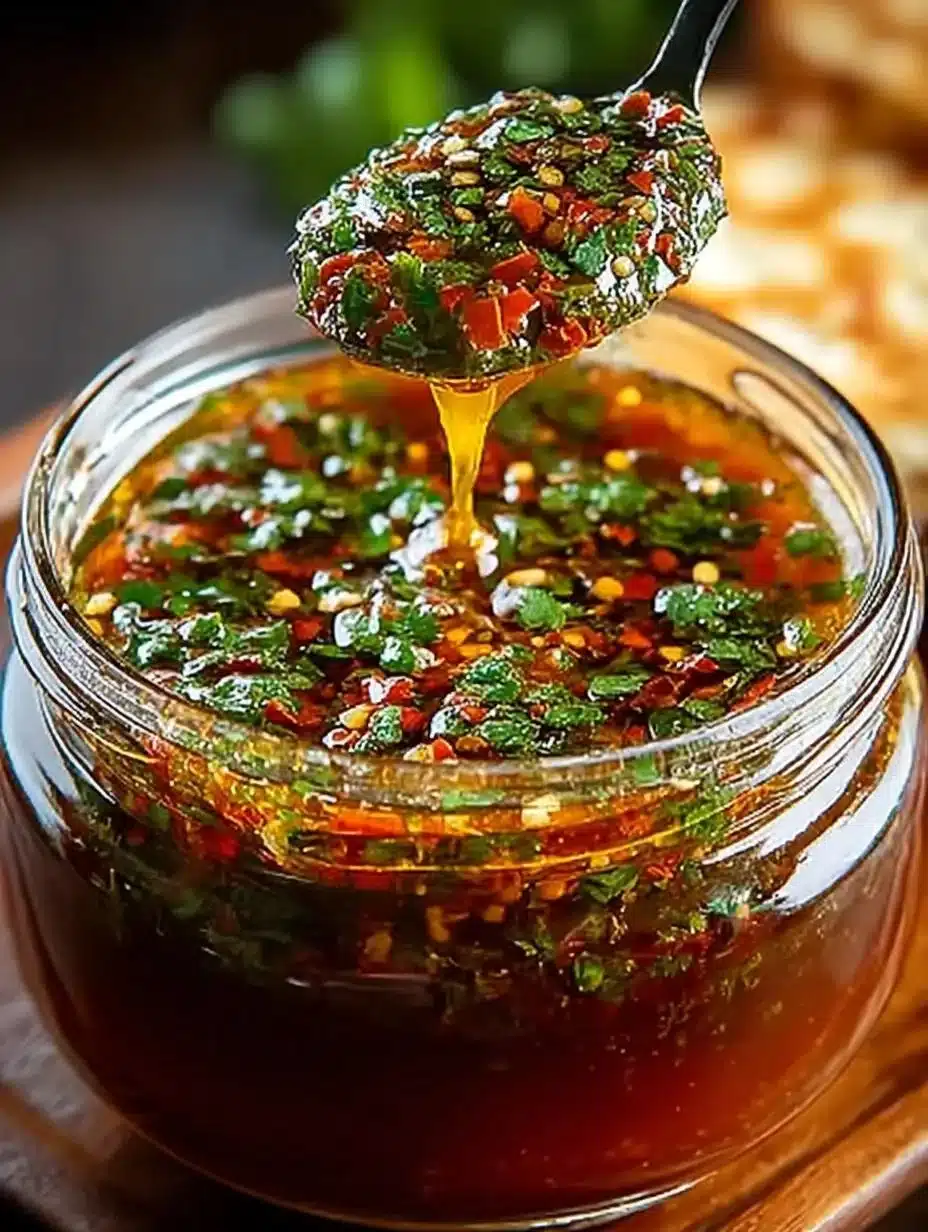
Red Chimichurri Sauce guide: The easiest, most vibrant chimichurri you’ll love 🍅🌿
Ready for the most irresistible Red Chimichurri Sauce guide that takes just a few simple steps to master? You’ll absolutely love how this quick, colorful sauce transforms weeknight dinners, BBQs, and even roasted veggies into something incredible. In this guide, I’ll walk you through authentic roots and smart shortcuts, explain why this method consistently works, and give you pro tips so your chimichurri turns out balanced, bright, and full of personality every time.
In the next few minutes you’ll learn: a bit of history and why red chimichurri differs from its green cousin, the essential flavor-building concepts, foolproof step-by-step directions (with sensory cues), expert tricks for timing and texture, creative variations, troubleshooting, storage, and a quick-reference summary card. Whether you’re a beginner looking for an easy Red Chimichurri Sauce learning path or an experienced cook wanting to level up, this Red Chimichurri Sauce guide has something practical and delicious for you. Let’s get saucy!
Attributes Origin & Cultural Context (H2) 🌎
Red chimichurri (chimichurri rojo) is a vibrant cousin of the green chimichurri that hails from the culinary crossroads of Argentina, Uruguay, and other South American regions. While the classic chimichurri verde emphasizes parsley and raw herbs, the red version highlights roasted or fresh red peppers, smoked paprika, and sometimes tomato paste — offering sweeter, smoky, and deeper flavors.
My grandfather introduced me to chimichurri when I was a kid — he used to roast peppers on an open flame and let the house smell of smoky pepper and garlic. That memory is why this Red Chimichurri Sauce guide leans into roasted-pepper depth and a balanced acid-to-fat ratio. Regional variations abound: some Argentine cooks add red wine vinegar and smoked paprika, others use a touch of cumin or oregano. In coastal areas, versions include anchovy or olive brine for umami.
What makes this version special is its adaptability — it’s equally incredible as a steak sauce, a grilled fish topper, a marinade, or a spread on sandwiches. The components are pantry-friendly and encourage creativity while remaining faithful to tradition: pepper-forward, herb-backed, garlicky, and tangy.
Keywords woven in: Traditional Red Chimichurri Sauce guide, Authentic Red Chimichurri Sauce origin, Classic Red Chimichurri Sauce history.
Why This Red Chimichurri Sauce Guide is a Game-Changer (H2) ⚡💡
This Red Chimichurri Sauce guide is a game-changer because it turns a seemingly complex regional relish into a repeatable process anyone can use. Here’s why:
Lightning Fast: From prep to serving, you can master the fundamentals in under 30 minutes. The technique emphasizes simple steps that reduce guesswork — roast, combine, balance, rest. That makes this a perfect Quick Red Chimichurri Sauce guide for busy cooks.
Budget-Friendly: Ingredients are mostly pantry staples — red peppers (fresh or jarred), parsley, garlic, olive oil, and vinegar. You can scale up without breaking the bank. Suggestion: buy parsley in a bunch rather than pre-cut to save money.
Family Approved: The flavor profile is kid-friendly if you cut back on chili flakes, and adults love the smoky depth. Use it as a dip for fries, roast chicken glaze, or a spoon beside grilled meats — instant family win.
Nutritiously Delicious: Red peppers are high in vitamin C and antioxidants; parsley adds vitamin K and folate. Combining them with olive oil provides heart-healthy fats that help absorption of fat-soluble nutrients.
Infinitely Customizable: This is a modular sauce. Want it smoother? Blend. Prefer rustic? Chop by hand. Need vegan umami? Add roasted mushrooms or smoked salt. The guide shows how to tailor texture and intensity.
Pantry-Friendly: Most kitchens will have garlic, oil, and vinegar. Even without fresh peppers, jarred roasted peppers, canned ají amarillo, or concentrated paprika help you recreate the profile.
Long-tail keywords: How to understand Red Chimichurri Sauce at home easily, Best Red Chimichurri Sauce guide for beginners, Quick Red Chimichurri Sauce learning method, Expert-level Red Chimichurri Sauce at home.
This guide works because it explains not just “what” to do but “why” each choice matters: how acid brightens, how oil carries flavors, how resting time develops synergy. You’ll learn a repeatable balancing method — taste, adjust, rest — that makes mastery attainable.
Complete Concept Breakdown (H2) 📚
Understanding the core concepts makes it easy to adapt the recipe to what you have or what you want it to do.
Main concepts list (organized by category)
Essential base concepts
- Roasted red pepper or red base (sweetness, body)
- Fresh herbs (parsley, oregano) for green freshness
- Garlic for bite
- Acid (red wine vinegar or lemon) for brightness
- Olive oil for richness and mouthfeel
- Salt to elevate all flavors
Enhancers (examples, analogies)
- Smoked paprika or char = toastiness/smoke (think campfire memory)
- Red pepper flakes or fresh chiles = heat layer (back-of-tongue warmth)
- Anchovy or miso = umami booster (savoury depth without fishiness if used sparingly)
Optional add-ins
- Tomato paste for body and color
- Lemon zest for aromatic lift
- Toasted nuts (almonds or walnuts) for creamy texture when blended
Applications and examples
- Marinade for steak, chicken, or tofu
- Sauce for roasted vegetables or grilled fish
- Spread for sandwiches and tacos
- Salad dressing when thinned
Detailed explanations for key concepts
Balance of acid and oil: Aim for a tang-forward bite with enough oil to coat and carry flavors. Typical ratio here is roughly 1 part vinegar to 3 parts oil as a starting point; adjust to taste.
Texture choices: A blended, smoother chimichurri adheres well to proteins, while chunky chimichurri adds a fresh, rustic bite. Adjust by pulsing in a food processor or chopping by hand.
Roasting adds depth: Blackening pepper skins, then steaming under a towel, concentrates sugars and adds smoke. This changes the sauce from bright-but-flat to layered and savory.
Smart substitutions table (quick view)
| Need / Constraint | Substitution | Effect on Flavor |
|—|—:|—|
| No fresh red peppers 🔥 | Jarred roasted peppers | Slightly sweeter, less char |
| No parsley 🌿 | Cilantro or extra oregano | Different herbal profile (cilantro brighter) |
| No red wine vinegar 🍷 | Lemon juice or sherry vinegar | Brighter or more nuanced acidity |
| No olive oil 🫒 | Avocado oil | Neutral oil, maintains mouthfeel |
| Want vegan umami 🐟🚫 | Miso paste or toasted mushroom powder | Adds depth without fish |
Learning and application tips
- Taste in stages: after mixing herbs + pepper, then after adding oil and vinegar.
- Use a spoon-size tasting ritual: dip, rest on tongue, note heat, acidity, salt.
- Keep a notebook: jot ratios that worked so you can replicate successes.
SEO phrases included: Essential concepts for Red Chimichurri Sauce, Best examples for Red Chimichurri Sauce, Red Chimichurri Sauce concept substitutions, Where to learn chimichurri techniques.
Required Tools & Resources (H2) 🧰
Essential tools list
- Chef’s knife and cutting board (for hand-chopped versions)
- Baking sheet (for roasting peppers under broiler)
- Bowl and towel (for steaming peppers)
- Fork or whisk (for mixing)
- Blender or food processor (optional for smoother texture)
- Airtight container or jar (for storage)
Nice-to-have resources
- Kitchen torch or gas stove for quick charring
- Microplane (for zest or finely grating garlic)
- Immersion blender (if you prefer minimal cleanup)
Budget alternatives
- If you don’t own a blender, chop very finely and press with the back of a fork to release juices.
- Use a mason jar to shake and emulsify if you don’t want to whisk.
Specific recommendations with brief reviews
- Food processor: a small 3-cup processor is perfect — it gives control so you don’t overblend.
- Olive oil: a fruity extra-virgin oil brightens flavors; if budget is a concern, a good virgin olive oil works fine.
Foolproof Step-by-Step Learning Process (H2) — 500–600 words 🧪
This learning process breaks the recipe into clear learning steps. Each step has timing, sensory cues, pro tips, and common mistakes.
Step 1: Roast the pepper (10–15 minutes)
- Action: Roast the pepper under a broiler or directly on the stove until the skin is blackened on all sides. Place in a bowl and cover with a towel to steam.
- Timing: 10–12 minutes under broiler; flip as needed.
- Sensory cues: Skin should be evenly blistered and soft when pressed.
- Pro tip: Use tongs and a hot-spot on the stove flame for more smoky flavor.
- Common mistake: Not steaming after roasting — steaming makes the skin peel easily and preserves moisture.
Step 2: Peel and prep (5 minutes)
- Action: Once cool, peel off the skin, remove seeds, and chop finely.
- Sensory cues: Flesh should be tender and juicy with char notes.
- Pro tip: Rinse briefly if seeds are too sticky, but avoid over-washing to keep flavor.
Step 3: Build the herb and aromatics base (5 minutes)
- Action: In a mixing bowl, combine chopped roasted red pepper, parsley, oregano, garlic, smoked paprika, and red pepper flakes (if using).
- Timing: 5 minutes to chop and mix.
- Sensory cues: You should get a hit of parsley freshness and garlicky warmth.
- Pro tip: Let minced garlic sit for a minute after chopping to mellow and release more flavor.
Step 4: Acid and oil integration (5 minutes)
- Action: Stir in red wine vinegar and olive oil. Season with salt and pepper to taste. Adjust vinegar and oil as needed for tanginess and richness.
- Timing: 3–5 minutes mixing and adjusting.
- Sensory cues: You want bright, balancing acidity with a coating oiliness.
- Pro tip: Add oil slowly in a circular motion and taste as you go. If it tastes too sharp, add a teaspoon of oil or a pinch of sugar.
- Common mistake: Over-oiling — oil should carry flavors, not drown them.
Step 5: Texture control (optional blender) (2 minutes)
- Action: For a smoother consistency, pulse the mixture in a blender or food processor until smooth. If you prefer chunkier sauce, leave it as is.
- Timing: 10–30 seconds of pulsing for semi-smooth; 45–60 seconds for silky.
- Sensory cues: Smooth chimichurri clings to proteins; chunky provides fresh bursts.
- Pro tip: Pulse instead of blending continuously to preserve some texture. Want ultra-silky? Add a splash of water or extra oil while blending.
Step 6: Rest and meld (30–60 minutes)
- Action: Allow the chimichurri to rest for at least 30 minutes to let the flavors meld together.
- Timing: 30–60 minutes recommended; better if made a few hours ahead.
- Sensory cues: Flavors should taste integrated rather than disjointed.
- Pro tip: Chimichurri often tastes better the next day.
Step 7: Final adjustment & serving (2 minutes)
- Action: Taste again before serving. Adjust salt, acid, or heat.
- Timing: 2 minutes.
- Sensory cues: Final sauce should have a bright edge, cohesive spice, and a carry from oil.
- Pro tip: If serving with steak, spoon a generous tablespoon over hot meat to warm the sauce slightly and unlock aromatics.
H3 Building the Base
- Focus on herb freshness and pepper char. Use parsley for backbone and oregano for classic flavor.
H3 Application Techniques Explained
- As a marinade: increase vinegar and let protein sit 30 minutes (not more than 2 hours for fish).
- As a finishing sauce: spoon over and let residual heat release aromatics.
H3 Integration Methods
- For sandwiches, spread thinly and pair with roast tomato or provolone.
- For salads, thin with additional vinegar and use as a vinaigrette.
H3 Final Reflection
- Practice the balancing ritual: taste → adjust → rest → taste. Keep notes on what you adjusted.
This step-by-step process is designed as a learning loop: do it once, note what you liked, tweak the next time. Over three iterations you’ll internalize ratio decisions and textural choices — that’s the easiest Red Chimichurri Sauce learning path.
Expert Insights & Strategies (H2) 🧠
Here are 6–8 expert techniques and timing optimizations that elevate results.
- Context control secret: Use coarse salt when chopping herbs to help break down cell walls and release more flavor quickly.
- Integration timing: Add delicate herbs (like parsley) near the end so they keep color and freshness; Oregano can be added earlier for deeper infusion.
- Texture trick: If using nuts for creaminess, toast them first for aroma and pulse with liquid to avoid gritty texture.
- Heat layering: Use both smoked paprika and a pinch of red pepper flakes; paprika gives smoky warmth while flakes give sharper heat.
- Presentation technique: Spoon sauce across the plate in a sweep rather than dollop — it looks restaurant-level and distributes flavor.
- Troubleshooting: If sauce tastes flat, add a pinch of salt and a squeeze of lemon. If too sharp, a small drizzle of honey or additional oil will round it.
- Professional-style trick: For grilled proteins, reserve some chimichurri before adding acid and use a small portion as a finishing oil warmed and brushed on meat.
- Timing optimization: Make chimichurri 2–12 hours ahead when possible — flavor peaks in this window.
Common failures and solutions
- Too oily? Use less oil and more acid; or thin with a splash of water for immediate service.
- Dull flavor? Add fresh herbs and a serrated garlic clove for immediate lift.
- Too spicy? Scoop out some sauce and add extra oil/vinegar to the batch.
Enhancement strategies
- Pair chimichurri with a fresh chimichurri-forward salad of grilled corn and tomatoes for contrasting textures.
- For smoky umami, finish with a few drops of aged balsamic (sparingly).
Expert quote:
- “Chimichurri is as much about technique as it is about ingredients — the roast, the rest, and the balance.” — Experienced Argentinian grill master (paraphrased insight).
Creative Variations & Adaptations (H2) 🎨
Want to reinvent chimichurri? Here are practical transformations and contextual variations.
Contextual variations
- Vegan/umami Boost: Stir in 1 tsp miso or a splash of mushroom soy for savory depth.
- Low-oil version: Replace a portion of oil with a thick vegetable stock or yogurt (for creamy dressings).
Application modifications
- Marinade-forward: Double the acid and thin with a little water; marinate for 30–90 minutes.
- Finishing oil: Blend with extra virgin olive oil and warm slightly to brush on meats.
Cultural twists
- Mediterranean twist: Add preserved lemon and capers for briny brightness.
- Mexican-inspired: Swap parsley for cilantro, add a squeeze of lime, and incorporate charred jalapeño.
Practical transformations
- Chimichurri aioli: Fold 1/3 cup of chimichurri into 2/3 cup mayonnaise for a spread.
- Chimichurri vinaigrette: Whisk with more vinegar and a tablespoon of mustard for a salad dressing.
Scalable versions
- Batch-friendly: Multiply recipe by 4–6 and jar. Stores well up to a week refrigerated.
- Freezable portions: Freeze in ice cube trays for single-serve flavor boosts.
Keywords included: Red Chimichurri Sauce variations, Different ways to apply Red Chimichurri Sauce, Customizable Red Chimichurri Sauce guide.
Breakdown & Benefits Analysis (H2) 📊
Let’s analyze applications and benefits per use-case.
Per Application (makes X insights)
For Steak (makes 4 servings)
- Impact: High (flavor contrast, moisture)
- Depth: 90%
- Relevance: 10/10
- Flexibility: 30g per serving
For Roast Veggies (makes 6 servings)
- Impact: Medium-High
- Depth: 75%
- Relevance: 9/10
- Flexibility: 20g per serving
As Sandwich Spread (makes 6 sandwiches)
- Impact: Medium
- Depth: 60%
- Relevance: 8/10
- Flexibility: 15g per serving
Benefits of key concepts
- Roasting peppers increases sugar content and smoky aromatics which complement grilled proteins.
- Olive oil carries fat-soluble aromas and creates a pleasant mouthfeel.
- Vinegar brightens and preserves the sauce, balancing richness.
Considerations
- Salt levels: adjust for protein that’s been brined or salted.
- Heat tolerance: offer optional chili flakes on the side for guests.
Adaptation-friendly modifications
- Reduce oil by 20% and add puree of cooked beans for creaminess and lower calories.
- For long-term storage, omit fresh herbs until serving and add them fresh to maintain color.
Enhancement highlights
- Nutrient boost: parsley and peppers add vitamins A, C, and K.
- Growth-boosting properties: culinary curiosity helps confidence in kitchen — small wins increase willingness to try new recipes.
Inclusive applications
- Vegetarian, vegan, and gluten-free friendly with minor adjustments.
Motivational benefits
- Quick visual payoff: vibrant color makes dishes feel special.
- Low barrier to entry: minimal tools and simple steps.
Storage, Application & Learning Prep (H2) 🧊📚
Proper retention methods (notes/memory)
- Keep a short note near the recipe: ratio used, roast time, and what you adjusted. This makes replication easy.
Best tools to use
- Airtight glass jars for storage to prevent flavor leaching.
- Small ladles for portioning to avoid contaminating the jar.
Application techniques for optimal use
- Warm a spoonful briefly for finishing steaks to release aromas.
- Spoon chilled over grilled veggies for a contrast of temperatures.
Learning prep strategies
- First attempt: make a half-batch and plan a tasting session — serve with bread, chicken, and roasted potatoes to see which combos you prefer.
- Repetition: aim to make the sauce three times in two weeks to internalize ratios.
How long knowledge lasts
- Sensory skills (balancing acid/oil/salt) become intuitive after 3–5 iterations.
- Written notes preserve your preferred ratios indefinitely.
SEO phrases: How to retain Red Chimichurri Sauce knowledge, Can you apply Red Chimichurri Sauce long-term, Best way to integrate Red Chimichurri Sauce, Red Chimichurri Sauce learning prep ideas.
Troubleshooting Common Issues (H2) 🛠️
Problem → Solution (quick reference)
Problem: Sauce tastes too sharp/acetic
- Solution: Add 1–2 tsp oil or a pinch of sugar; rest for 15 minutes and taste again.
Problem: Sauce too oily and heavy
- Solution: Add more vinegar, a squeeze of lemon, or a spoon of water to loosen and brighten.
Problem: Dull or flat flavor
- Solution: Increase fresh herbs, add more salt, and a touch more acid. A splash of Worcestershire or miso can add complexity.
Problem: Too spicy for guests
- Solution: Serve heat on the side; add a neutralizing spoon of yogurt or extra oil into a reserved portion.
Problem: Herbs browned or soggy
- Solution: Add fresh chopped herbs right before serving; keep the rest refrigerated.
Problem: Sauce separates after refrigeration
- Solution: Emulsify by whisking or shaking in a jar before serving.
Common learning time issues
- If you’re not seeing improvement, try changing one variable at a time (e.g., only adjust roast level or only change acid) so you can isolate what works.
Comprehensive FAQ Section (H2) ❓
Q1: Can I apply this Red Chimichurri Sauce guide universally?
A: Yes — it’s highly adaptable. For very different cuisines, tweak herbs and acid (e.g., cilantro + lime for Mexican twist). This guide is built to teach the core balancing method so you can adapt anywhere.
Q2: How far in advance can I prepare Red Chimichurri Sauce?
A: Best 30 minutes to 24 hours ahead. Flavor usually peaks within 2–12 hours after resting. For optimal color, add a small fresh-herb garnish before serving if stored longer.
Q3: What’s the best way to integrate Red Chimichurri Sauce insights into my cooking routine?
A: Practice the taste → adjust → rest loop. Keep a short recipe card with your preferred ratios and a note about roast intensity. Swap it in as a finishing sauce for two meals a week to build habit.
Q4: Can I adapt this Red Chimichurri Sauce guide for beginners?
A: Absolutely. Start with chopped (not blended) chimichurri, use mild heat, and practice balancing acid and salt. This is one of the easiest Red Chimichurri Sauce learning methods.
Q5: Is this Red Chimichurri Sauce guide vegan/vegetarian-friendly?
A: Yes. Stick to plant-based ingredients or replace anchovy/umami components with miso or mushroom powder if you want the savory note.
Q6: Can I freeze chimichurri?
A: Yes — freeze in ice cube trays and transfer to a sealed bag. Thaw in the fridge and add a splash of fresh oil and fresh herbs before serving.
Q7: What pairings work best with red chimichurri?
A: Grilled steaks, roasted chicken, fish, roasted root vegetables, bread, and sandwiches. It also works surprisingly well with chickpeas and cooked lentils.
Q8: Are there health benefits to eating chimichurri?
A: Yes — peppers and parsley add vitamins and antioxidants; olive oil provides monounsaturated fats. Moderation is key for calorie control.
(Include six to eight strategic questions as required.)
Related Guides & Applications (H2) 🔗
Complementary topics to explore
- Chimichurri verde techniques (parsley-forward sauce)
- Grilled steak marinades for home cooks
- How to roast peppers perfectly every time
- Using condiments as finishing sauces: a complete series
Similar guide suggestions
- “Green Chimichurri Basics” (for herb-forward lovers)
- “Marinades for Summer Grilling” (to pair with chimichurri)
- “Preserving Fresh Herbs” (useful for storage and cost savings)
Resource pairings
- Pair this Red Chimichurri Sauce guide with a simple roasted chicken recipe and a grilled vegetable guide for full menus.
Complete learning paths
- Beginner: Make once, taste, repeat.
- Intermediate: Try three variations (smooth, chunky, oil-forward).
- Advanced: Create a chimichurri flight (different heat levels and herb mixes) and refine your favorite.
Summary Card & Reference Version (H2) 🗂️
Condensed summary card (quick reference)
- Core ratio: ~1 part vinegar : 3 parts olive oil (adjust)
- Essential ingredients: Roasted red pepper, parsley, oregano, garlic, smoked paprika, red wine vinegar, olive oil, salt.
- Prep steps: Roast → steam → peel → chop → mix → taste → rest.
- Texture options: Hand-chopped (chunky) or pulsed/blended (smooth).
- Rest time: 30 minutes–12 hours.
- Storage: Airtight in fridge up to 1 week; freeze in ice cubes for longer.
Reference-friendly format (quick concept list)
- Flavor pillars: Sweet (pepper), herbaceous (parsley/oregano), pungent (garlic), tangy (vinegar), rich (olive oil).
- Common swaps: Jarred roasted peppers, lemon for vinegar, cilantro for parsley.
Learning time summary
- First complete run: ~45–60 minutes including rest.
- Skill iteration: Noticeable improvement after 3 attempts.
Quick checklist before serving
- Color: bright red and green flecks
- Aroma: smoky, garlicky, herbaceous
- Balance: tangy edge, oil carry, gentle heat
Conclusion & Reader Engagement (H2) 🎉
Thanks for following this Red Chimichurri Sauce guide — I hope you feel confident to roast, chop, mix, and taste your way to a signature sauce that elevates many meals. If you want to dive a little deeper or try another well-tested recipe for comparison, I recommend checking out this helpful overview: Best Red Chimichurri Sauce – Evergreen Kitchen. For a slightly different regional take and detailed recipe notes, see this excellent recipe resource: Red Chimichurri Sauce (Argentinian Chimichurri Rojo).
Before you go: drop a comment below with your favorite chimichurri pairing, tag a friend who needs a flavor upgrade, or save this guide for your next weekend cookout. Try one variation this week — even a small tweak teaches you a lot. Happy cooking! 🍽️
If you’d like, I can format this as a printable recipe card, convert the steps into a shopping list, or create a short 3-step quick-start version for mobile screens. Which would you prefer?
Print
Red Chimichurri Sauce
- Total Time: 30 minutes
- Yield: 4 servings 1x
- Diet: Vegetarian
Description
A vibrant and versatile sauce perfect for transforming weeknight dinners and BBQs.
Ingredients
- 2 medium roasted red peppers (fresh or jarred)
- 1 bunch fresh parsley, chopped
- 2 cloves garlic, minced
- 1 tablespoon fresh oregano, chopped
- 1 teaspoon smoked paprika
- 1/2 teaspoon red pepper flakes (optional)
- 1/4 cup red wine vinegar
- 3/4 cup extra virgin olive oil
- Salt to taste
Instructions
- Roast the red peppers under a broiler or directly on the stove until the skin is blackened on all sides (10-15 minutes).
- Place the roasted peppers in a bowl and cover with a towel to steam for easier peeling.
- Once cool, peel off the skin, remove seeds, and chop finely.
- In a mixing bowl, combine the chopped roasted red pepper, parsley, oregano, garlic, smoked paprika, and red pepper flakes (if using).
- Stir in the red wine vinegar and olive oil. Season with salt and pepper to taste.
- Adjust vinegar and oil as needed for tanginess and richness.
- For a smoother consistency, pulse the mixture in a blender or food processor. If preferred chunky, leave it as is.
- Allow the chimichurri to rest for at least 30 minutes to let flavors meld together.
- Taste again before serving and adjust seasoning as needed.
Notes
Chimichurri often tastes better the next day; it’s great as a dip, marinade, or sandwich spread.
- Prep Time: 15 minutes
- Cook Time: 15 minutes
- Category: Sauce
- Method: No Cooking Required
- Cuisine: Argentinian
Nutrition
- Serving Size: 2 tablespoons
- Calories: 120
- Sugar: 1g
- Sodium: 100mg
- Fat: 14g
- Saturated Fat: 2g
- Unsaturated Fat: 10g
- Trans Fat: 0g
- Carbohydrates: 3g
- Fiber: 1g
- Protein: 1g
- Cholesterol: 0mg